16 MAR 2017
Lovecraft in Popular Culture. The Gentleman of Providence, Eighty Years After His Passing
By Diego Vilchis (@silens_aeternum)
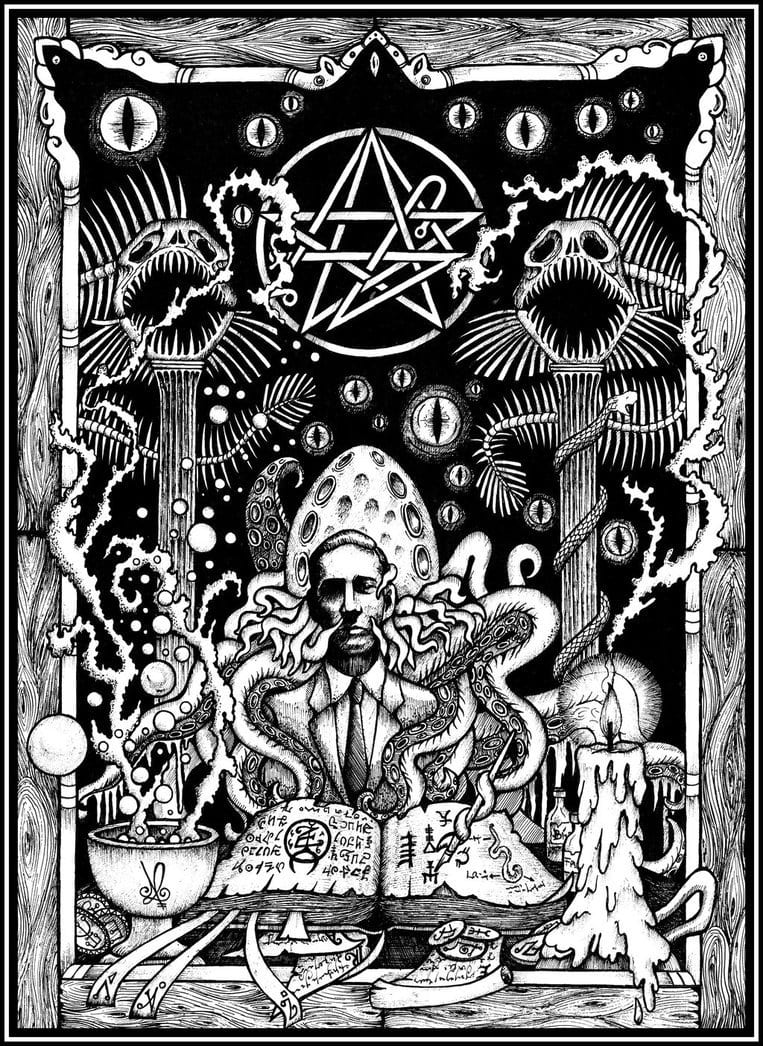
On March 15, 1937, at the age of forty-six, American writer Howard Phillips Lovecraft died in his native Rhode Island, confined by the intestinal cancer he had been suffering from for some time. During his lifetime, his writing appeared mostly in publications like Weird Tales, in work for other writers and under pseudonyms, as well as in the vast body of correspondence on record. It was only after his death, as with some other writers, that his creative legacy bore fruit. Today, the gentleman of Providence is one of the great masters of horror and one of the pillars of the genre in the twentieth century.
A child prodigy who had been writing since the age of six, his interests showed the versatility with which his voracious mind and boldness ranged: from One Thousand and One Nights (which influenced the creation of Abdul Alhazred) and vast Greek mythology, to chemistry and astronomy (the first publication he founded was The Scientific Gazzet, at the age of nine). He was equally fond of poetry and science. Whipple Van Buren Phillips, his maternal grandfather, was largely responsible for surrounding young Howard with those walls built of books.
We cannot overlook the almost inevitable relationship between genius and tragedy: from an early age he frequently suffered from both physical and psychological ailments; the deaths of his grandfather and his mother, as well as the suicide of his close friend Robert E. Howard, marked him both financially and emotionally. Depression accompanied him at various points in his life, contributing, among other factors, to an isolation that was already familiar to him.
Lovecraft's literary output was extensive. In fiction, his work could be divided into stages, passing through the influence of the Gothic, the so-called 'dream cycle,' and of course his best-known, most extensive, and most acclaimed work: the Cthulhu Mythos. However, he also wrote works about literature, such as Supernatural Horror in Literature (1927), one of the most important essays on horror literature; likewise, he also collaborated on scientific and journalistic projects, such as the United Amateur Press Association and The Providence Tribune
Sheltered under the mantle of Poe, Dunsany, Blackwood, and Machen, to name a few, he inked in black the letters of his apocryphal descriptions and his forbidden chronicles of what lies hidden from eyes foreign to the human lineage, at the edge of forbidden verses (yes, cursed books!) and the window onto an abominable oneirism. His style is a detailed assertion of the unimaginable.
Eighty years after his passing, the impact of his work reverberates in contemporary popular culture
Literature
Perhaps the most immediate impact was on literature. He had already built relationships with several writers through letters when the now well-known 'Lovecraft Circle' formed, which helped swell the ranks of the Cthulhu Mythos. After his death, August Derleth, one of his closest friends, and Donald Wandrei founded the publishing house Arkham House with the aim of rescuing and publishing Lovecraft's work. The 'Circle' did not disband: Clark Ashton Smith, Robert Bloch, and Frank Belknap Long continued expanding the profane mythology.
Stephen King wrote the story Jerusalem’s Lot (1978), linked to his novel Salem’s Lot (1975), resulting in a masterful tribute to the writer from Rhode Island. Jorge Luis Borges wrote There Are More Things in The Book of Sand (1975), just like King, as a tribute.
Music
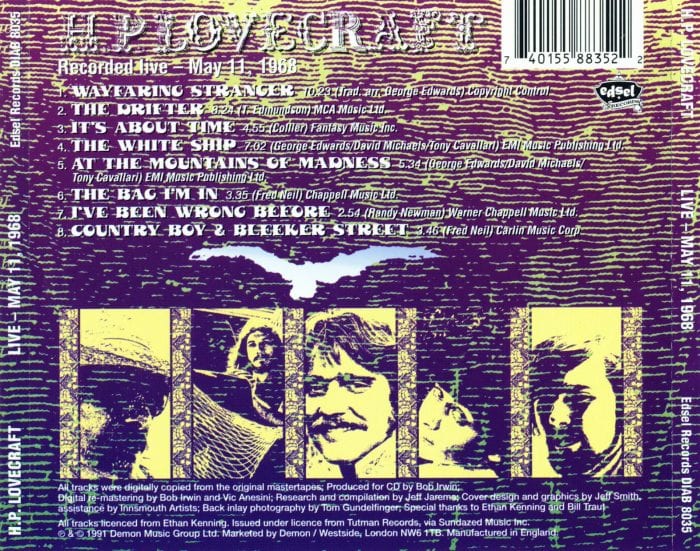
The most profound musical impact of Lovecraft's work has almost always centered on the metal genre. This is hardly surprising given the themes explored by the American writer: a cosmogony of his own, fed by mythology in general and the occult.
A well-known case is Metallica, who wrote 'The Call of Ktulu,' included on Ride the Lightning (1984), as well as 'The Thing That Should Not Be' on Master of Puppets (1986), based on the story The Shadow over Innsmouth; Black Sabbath wrote 'Behind the Wall of Sleep' for their self-titled 1970 album; Cradle of Filth did the same with 'Cthulhu Dawn' on Midian (2000), and their album Lovecraft & Witch Hearts (2002); Dream Theater, with 'Dark Eternal Night,' based on Nyarlathotep, included on Systematic Chaos (2007); Therion, for their double album Lemuria /Sirius B (2004), includes the track 'Dagon'; the psychedelic rock band H.P. Lovecraft is an entire tribute to the writer and his work.
Audiovisual Media
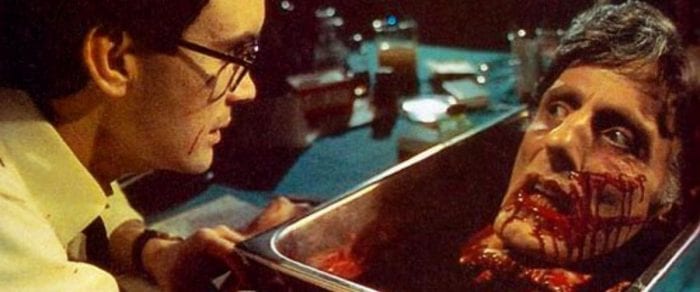
The world of film includes several adaptations of Lovecraft's work, but the films made by Stuart Gordon and Dennis Paoli stand out: Re-Animator (1985), From Beyond (1986), and Dagon (2001), as well as the episode Dreams in the Witch-House for the first season of Masters of Horror (2005).
Several titles have also appeared on video game screens: Eternal Darkness: Sanity’s Requiem (2002); Alone in the Dark (1992); Call of Cthulhu: Dark Corners of the Earth (2005); The Last Door (2013), to name a few.
On the small screen, in season fourteen of South Park, Cartman summons Cthulhu for his own personal gain. In Treehouse of Horror XXIV on The Simpsons, Lovecraft appears with Poe, drinking coffee. In the animated Ghostbusters series, an entire episode is devoted to the Cthulhu Mythos.
Eighty years after his passing, Lovecraft's legacy is the uncertain shadow that persists through the eons, embracing us with its arcane mantle and lying hidden in the dreaming consciousness, among mausoleums raised by forgotten minds, and the penetrating darkness that resounds, shudders… and whispers.
The gentleman of Rhode Island murmurs from those desolate places, confined beneath unnamable signs. His sentence, like his epitaph, is absolute:
I am Providence.