10 DEC 2022
The Christmas Parade of the Dead Horse: A Look at the Mary Lwyd Celebration
By Diego Vilchis
The Christmas season has arrived! Time to decorate the house, put up the tree with lights and colorful ornaments, and have jingles playing everywhere. And of course, the ponche, that delicious hot fruit drink whose aroma brings us comfort against the cold this time of year. What better way to enjoy it than while we wait to hear the carolers asking for posada. But they don't sound like carols, they're in another language… What could it be? There's a knock at the door, and when it opens, people are singing joyfully while holding up a decorated horse skull and… What? A horse skull?
Yes, that's right! It's Mari Lwyd! Come on in!
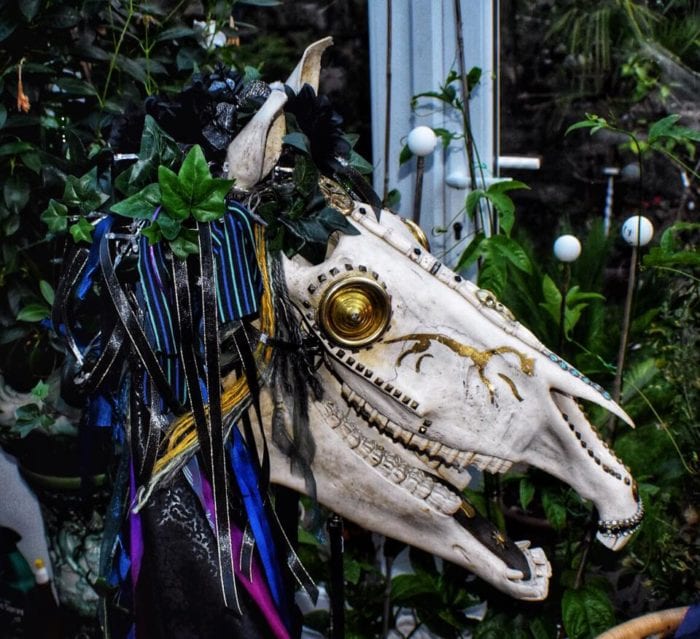
The Color of the White Horse
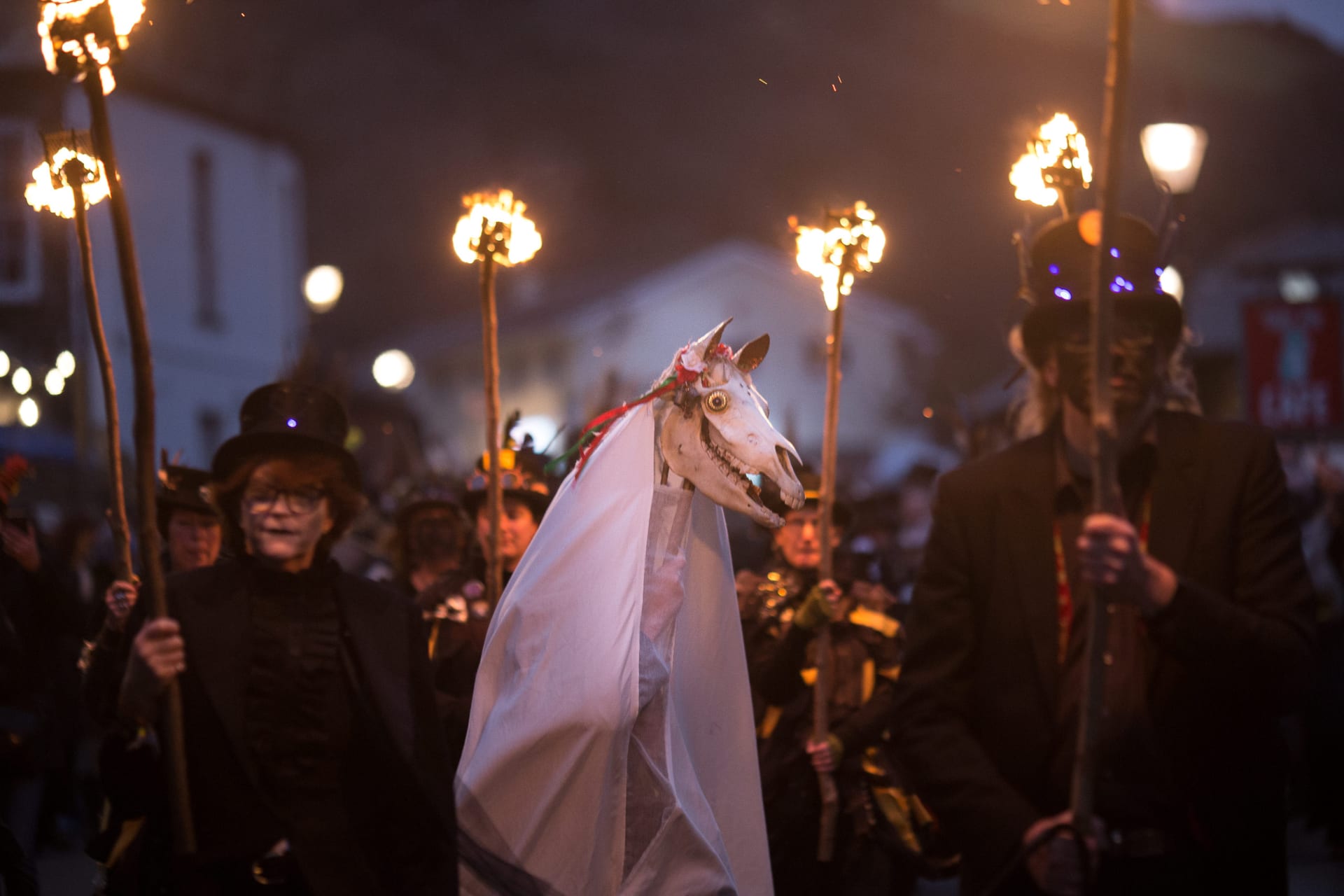
The Mari Lwyd celebration is a tradition from South Wales that takes place during the Christmas and New Year holidays, in which a group of people goes from house to house singing and asking for posada, until they are welcomed into one. The distinctive feature of this celebration is that one person is in charge of carrying a decorated horse skull mounted on a pole: baubles or mirrors are set into the eye sockets, and ribbons and bells hang from the head, which is covered with a colorful cloak like a hood.
In this way, the group carrying Mari Lwyd makes its way through the streets, between houses and pubs, until they arrive to ask for posada. Then they sing songs in Welsh (wassails), or even something more traditional: a somewhat “unfriendly” exchange of rhymes known as pwngco between those asking for posada and the residents of the houses, who make excuses not to let them in. However, once there's no reason left to refuse, the colorful skull and the group of people accompanying it are welcomed inside. Once inside, the friendly festivities begin with singing, music, food, and drink, while the skeletal, horse-like figure of Mari Lwyd wanders through the house, snapping its jaw to scare the children (and even adults), all as a sign of prosperity and good fortune.
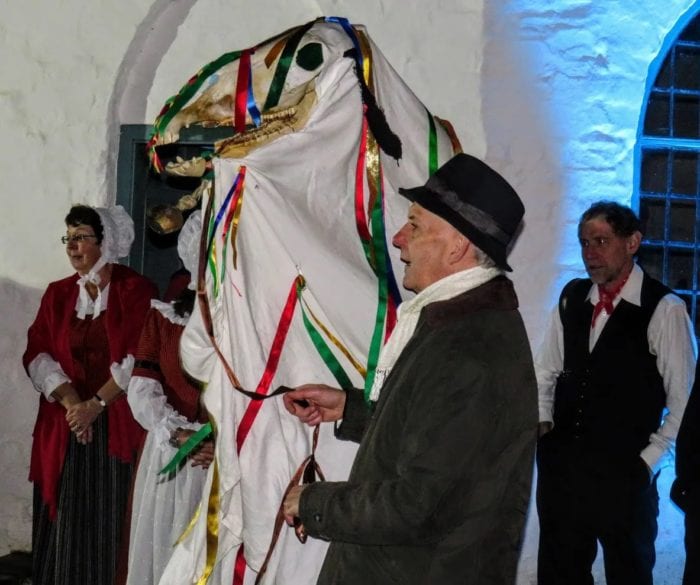
Galloping Through the Background of the Celebration
The origins of Mari Lwyd are not entirely clear. Some historians link it to Christianity in the British Isles, hence why its name is "Mari" (an obvious association with Mary, the mother of Christ), interpreting "Mari Lwyd" as something like "Holy Mary"; however, other scholars suggest that the celebration's roots are more pagan and pre-Christian, and that the etymology comes from Old Welsh, meaning "grey mare," celebrated closer to Samhain and associated with a fertility ritual.
What is certain is that it wasn't until 1800 that the first written record of this tradition appeared, in the book A Tour through Part of North Wales, by J. Evans, and although the book focuses, as its title indicates, on North Wales, it also covers the country's traditions in general. It's also worth noting that the Mari Lwyd celebration is part of a series of customs involving hooded animals throughout Great Britain: Hoodening, in Kent; the Old Tup, in Derbyshire and Yorkshire; Obby Oss in Padstow, and Minehead Hobby Horse, in Somerset.
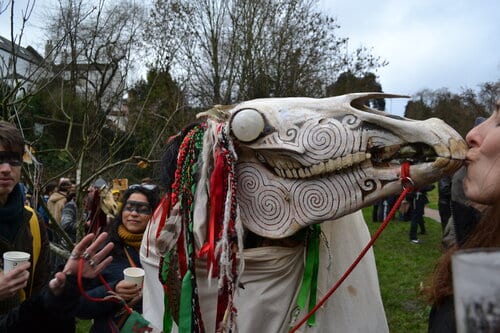
Resurrecting the Dead Horse
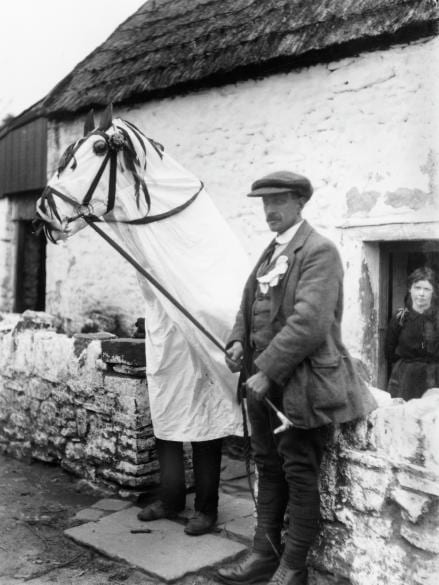
Despite its inherent peculiarity, and along with other traditions and customs, the Mari Lwyd celebration declined during the 19th century as a result of the Methodist revival in Wales. Evidence of this can be found in the book The religion of the dark ages (1852), by Reverend William Roberts, who condemns it and describes it as "sinful," stating that it should only be displayed in history museums, which, along with other factors, caused Mari Lwyd to fade away.
Despite this, by the first half of the 20th century, folklorist Iorweath Peate found that between 1930 and 1940 the tradition was still active in some regions of Wales. In 1941, after hearing about the ritual's practice, Welsh poet Vernon Watkins wrote his long poem "The Ballad of the Mari Lwyd." One example of the many verses it contains is the following:
None can look out and bear that sight, (No one can watch and bear that sight)
None can bear that shock. (No one can bear that shock)
The Mari’s shadow is too bright, (Mari's shadow is too bright)
Her brilliance is too black. (Her brightness is too black)
None can bear that terror (No one can bear such terror)
When the pendulum swings back (When the pendulum swings back)
Of the stiff and stuffed and stifled (Of the stiff, the stuffed, and the stifled)
Gleaming in the sack. (Gleaming in the sack)
Throughout the second half of the 20th century, the tradition began to revive and spread across the country. Today, the practice of Mari Lwyd helps preserve ancient customs in Wales, giving people a sense of identity. Various organizations have worked together with schools to get younger generations involved in its preservation. As a result, they are beginning to see and embrace Mari Lwyd as part of their history: an ancestral heritage worth preserving that, accompanied by music and singing, brings joy and good fortune.
So if you hear a ghostly chattering sound on a December night, don't hesitate. It's Mari Lwyd! Invite her in and celebrate the season with good fortune, music, food… and, why not, the occasional scare.
Sources:
https://www.wales.com/about/culture/mari-lwyd
https://en.wikipedia.org/wiki/Mari_Lwyd
https://rhinwedd.cymru/blogs/news/the-story-of-mari-lwyd
Photos:
Mari Lwyd 1
Photo: Mari Celeste (abre en nueva pestaña)
Mari Lwyd 2
Photo: Amgueddfa Cymru - National Museum Wales (abre en nueva pestaña)
Mari-Lwyd3
Photo: Kyra Cornelius Kramer (abre en nueva pestaña)
Mari-Lwyd4
Photo: Sarah Keen for Enchanted England (abre en nueva pestaña)
procession1