24 JUL 2017
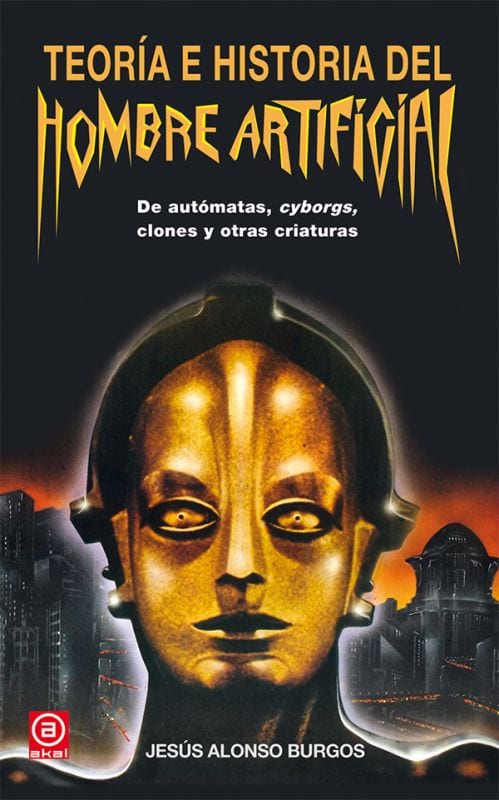
Building the Homo Artificialis: A Review of Teoría e historia del hombre artificial.
By: Diego Vilchis (@silens_aeternum)
“Artificial,” which comes from the Latin artificiālis, means that something so called is made by man, produced by his ingenuity[1]. The idea of artificial life is not a recent one; on the contrary, it has been around for centuries, viewed from different perspectives, whose foundation lies even in religion and philosophy.
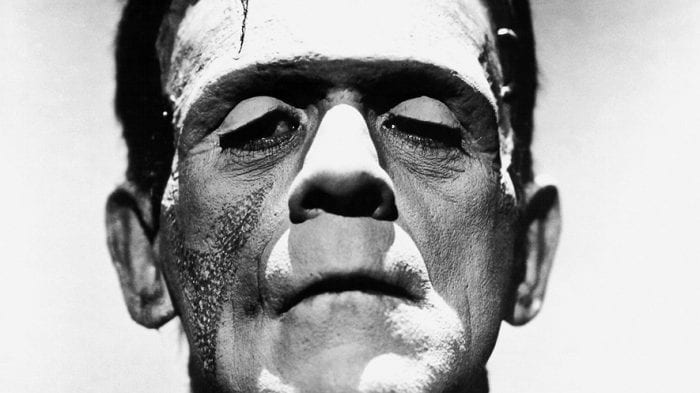
Taking Frankenstein as an axis, Teoría e historia del hombre artificial, by Jesús Alonso Burgos, explores the different angles from which the creation of life by man's own hand is not necessarily a matter that stems from science fiction (although it inevitably passes through it). It is an extensive essay that delves into the ideas, texts, and archetypes that lay the groundwork for this thesis.
In fact, we can even see man himself as a machine that operates under the laws of physics, as the author cites Descartes. From that very point, we can understand that the scope must extend, even, into the collective imagination and rational thought: aren't those supernatural creatures of the Dark Ages, those chimeras, a product of the human mind? Superstition, that specter that feeds and is fed by folklore, is the machinery through which this hybridization occurs: those who steal human blood and feed on it to survive, those who have wings and devour carrion, or perhaps those who live in the sea, and also those whose bodies or heads belong to another species. Man's imagination casts forth its ‘artificial men.’
Religion also has its own takes on the subject: the author presents Cain as a precursor to the modern Prometheus, since he is the creator of agriculture, appropriating nature, and of blacksmithing: he invents and develops technique (tecne) – the mechanization of man; the divine lineage becomes earthly. From that same matter of the earth arises the golem, that colossus which, according to the legend of Prague, was created by Rabbi Loew in the 16th century, although it was not the first time: other rabbis of the Middle Ages had also taken clay to give it shape and life (just as man was made) by writing the name(s) of God on it; in a way, mythology – especially Greek mythology –, which served as the worldview that dominated ancient religious thought, gives us anthropomorphic gods who create hybrids.
But it is at the heart of Romantic literature that the quintessential specimen is created: Mary Shelley, after that discussion about Erasmus Darwin's experiments on the reanimation of dead matter and, literally, a dream on a summer night, breathes the spark of life into Frankenstein; or, The Modern Prometheus (1818). Man, imitating the Creator, had engendered life from inanimate matter - or in this case, dead matter -, not through magic or religion, but through scientific experimentation: the artificial man par excellence. It would not be the only example: there is also Herbert West—Reanimator (1922), by Lovecraft.
The mechanical man, the automaton, whose designs across several centuries were intended to imitate human activity, is the tangible feat of replicating ourselves: Leonardo Da Vinci had designed them, although he was not the first; René Descartes, it is said, built one after the death of his daughter. Anthropomorphic (naturally), talking heads, chess players, or ones whose ability was to replicate the skill of writing, automatons inspired not only science in the pursuit and success of building or creating a specimen worthy of imitating human life, capable of thinking and feeling. There are even parallels in the genetic code that distinguishes us as living beings: duplicating ourselves through cloning; this inspiration also carries over into science fiction, a narrative genre that, in modern popular culture, projects onto its screens the visionary imagination forged over decades of celluloid: Metropolis (1827), by Fritz Lang; the adaptation of The Wizard of Oz (1939), by Victor Fleming; Blade Runner (1982), by Ridley Scott; Terminator (1984) by James Cameron, and the entire saga that follows from the Connors, or Robocop (1987) by Paul Verhoeven; even Edward Scissorhands (1990) by Tim Burton, and of course, the adaptations of Isaac Asimov's work: Bicentennial Man (1999) and I, Robot (2004).
In sum, Teoría e historia del hombre artificial is a necessary contribution to a subject that, like the horror genre, could go unnoticed without the disciplines that examine it: here, most fortunately, the criteria and foundations of knowledge are established to deepen and understand it, since it is a complex subject that needs to be understood through the history of culture, its glimpses in religion and in philosophy, which are nothing more than emblems of human thought on an idea that is almost primordial: that of having the capacity to create something as astonishing as human life itself.
[1] http://dle.rae.es/?id=3rM0tTc. Date accessed: 14/07/2017