
19 JAN 2018
One More Year Without Poe
By: Casandra Vicario
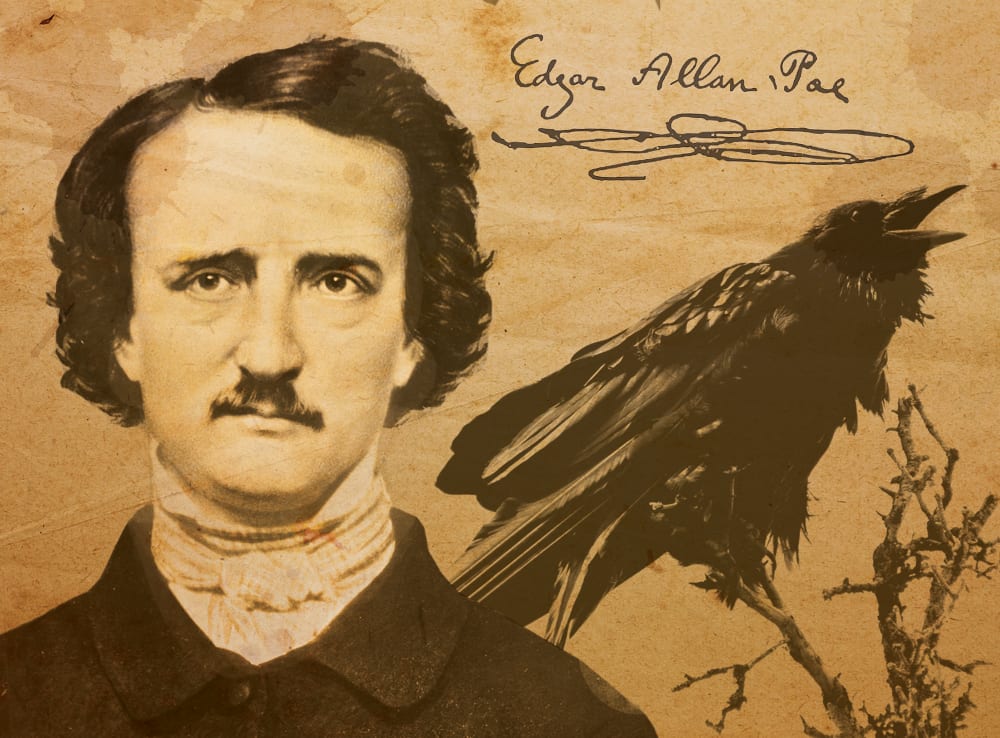
On January 19, it will be one more year since the birth of writer Edgar Allan Poe, found guilty of introducing many of us to the world of fantasy, detective, and horror literature.
Much is said and known about this author's life, but little is said about the details surrounding his death, which is a case worthy of an investigator like Auguste Dupin, created by Poe, who made his literary debut in 1841 in the story "The Murders in the Rue Morgue."
Poe disappeared on September 27, 1849, having told his fiancée about a trip to Philadelphia, but nothing was heard from him until six days later, when he was found on the streets of Baltimore, dirty, nearly unconscious, and wearing someone else's clothes.
It was Joseph Walker who managed to get Poe to give the name of a friend, who turned out to also be an acquaintance of Walker's, and he immediately contacted him to let him know about the terrible situation the writer was in.
That is how Dr. Snodgrass came to meet with Poe, who was in terrible health and out of his senses; he was taken to a hospital in Washington, but the doctors could do nothing for him.
he also spent some time mentioning the name "Reynolds"
On October 7, Poe's body stopped beating and breathing; his last words were "Lord, help my poor soul." What happened to Edgar Allan Poe during those days when he went missing? No one has been able to give a reasonable explanation for it.
From the little documentation that exists on the matter, it is known that there was no autopsy performed on the writer's body, and the medical reports have "gone missing." What we do know is that Edgar Allan Poe was buried at Westminster Presbyterian Church, and for many years his grave lacked a headstone or a name to identify it.
In 1860, a nephew of Poe's named Neilson had a headstone made, but a train derailed and damaged the workspace of the sculptor in charge of the job, and the only headstone that was destroyed was that of the Baltimore-based writer. His nephew did not have the money to make a new monument.
It wasn't until 1875 that the group "Pennies for Poe" managed to raise funds to build a marble and granite monument for the deceased writer. And then, a second mystery arises surrounding Edgar Allan Poe's death, known as the "Poe Toaster."
Every January 19, the writer's birthday, a figure dressed in dark clothing, face covered with a scarf and leaning on a cane, would visit the place where Poe's remains rested for a time, during the early hours of the morning, and would leave three red roses and a bottle of cognac on Poe's grave.
Members of the press and curious onlookers in general have tried to identify the person, but they have had no luck; the photographs that have been obtained of him (or her) turn out to be blurry.
It is said that the three red roses placed by the figure in question represent Edgar Allan Poe, his young wife Virginia, and his mother-in-law Maria Clemm, the three of whom were supposedly buried in the same place.
The appearance of the so-called "Poe Toaster" began in 1949 and stopped in 1998; it later made a few sporadic appearances, such as the one that occurred in 2009, the year marking the bicentennial of master Poe's birth, and after that, this mysterious figure — now awaited every year by thousands of onlookers, "Nevermore" — has appeared once again.
Today, "Macabro" remembers this great master of horror, always adored, never forgotten: Edgar Allan Poe.